Choosing Smart Tinting Glass is not just a question of privacy or appearance. The right choice depends on how a space is used, how much daylight it receives, and what the project can support. A meeting room may need quick privacy on demand, while a sun-facing façade may prioritize glare control and heat management. Small details matter. Glass size, wiring routes, control access, and edge conditions can all affect the finished installation.
This guide explains how to compare key options, including switching technology, optical clarity, response time, power requirements, and control systems. It also considers practical questions: Will the glass fit existing frames? Is a dimmer tint acceptable, or is clear visibility essential? What maintenance and warranty support does the supplier provide? Product performance varies, so check technical data and ask for a sample under the project’s actual lighting conditions. A showroom demonstration can look convincing; real daylight may feel different. That is worth admitting early.
A reliable selection process starts with clear requirements and verified specifications, not a striking product photo. Compare installation needs, operating costs, and expected use before making a decision. Smart Tinting Glass can improve comfort and flexibility, but it is not a universal fix for poor shading or unsuitable building design. The best choice is the one that meets the project’s specific needs and can be installed and maintained with confidence.
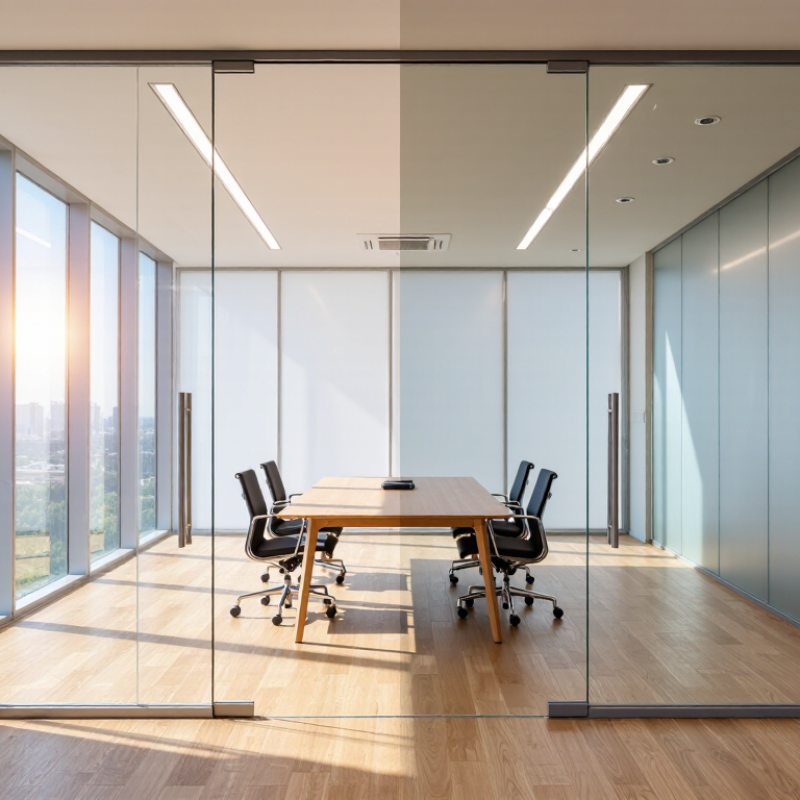
Start with the room. Map its orientation, window area, occupancy, and existing shades. A west-facing meeting room may need afternoon glare control, while a north-facing studio may need to preserve daylight. Note when direct sun reaches desks, screens, or display surfaces. Small details matter.
The U.S. Department of Energy’s Energy Saver guidance estimates that windows account for about 25–30% of residential heating and cooling energy use. Treat this as context, not a project forecast: climate, installation, and building design change the result. Define measurable goals for glare, daylight, privacy, and solar heat gain before comparing products. That makes trade-offs visible. A darker tint may reduce glare but also dim the room and increase reliance on electric lighting.
Ask for tested visible light transmission and solar heat gain coefficient values in both clear and tinted states. Check switching time, power use, color appearance, and the glass’s behavior during a power interruption. This part is easy to underestimate. Request a sample and view it beside an actual desk at different times of day. One more check: confirm the proposed glazing suits the frame and the project’s thermal requirements, rather than choosing by tint appearance alone.
Smart tinting glass does not work through one universal mechanism. The main options behave differently when power changes, so compare their switching speed, appearance, and control needs against the project’s daily use.
Polymer-dispersed liquid crystal glass, or PDLC, scatters light when unpowered. Apply voltage, and its liquid crystals align, making the panel look clearer. It switches quickly, which suits meeting rooms needing privacy on demand. Yet “clear” may still look slightly hazy, and PDLC usually needs power to remain transparent. Check a full-size sample under the room’s actual lighting.
Suspended-particle devices use electrically aligned particles. In many designs, the unpowered glass is dark; applying power makes it more transparent. This can help manage glare and daylight, but the view and color may differ from ordinary clear glass. Electrochromic glass changes tint as ions move between material layers. It often adjusts more gradually and can hold a tint with little or no continuous power. That slower response may be fine for a façade, less so for a fast privacy screen.
Small details matter. Ask how each option handles edges, heat, and repeated switching. A showroom sample is not the whole window. I would also question any comparison based only on a single “clear” photograph. The best choice depends on the intended state, wiring access, and how occupants actually use the space.
| Technology | Operating principle | Typical unpowered state | Typical powered or activated state | Switching and control | Privacy and view | Best suited to | Key selection considerations |
|---|---|---|---|---|---|---|---|
| Polymer-dispersed liquid crystal (PDLC) | Liquid-crystal droplets are dispersed in a polymer layer. With no voltage, the droplets scatter light; an applied electric field aligns them to transmit light more directly. | Usually translucent or frosted, providing visual privacy while still allowing diffused light through. | Usually switches to a clearer, more see-through state. It does not necessarily become optically clear like conventional glass. | Electrical switching is generally rapid. The clear state normally requires continuous power; controller and voltage requirements depend on the product. | Strong for on-demand privacy. The frosted state obscures detail but is not a blackout and may still transmit light and shadows. | Meeting rooms, interior partitions, healthcare spaces, doors, and privacy windows. | Check visible-light transmission, haze in the clear state, privacy performance, panel size limits, wiring, and whether the system is suitable for exterior exposure. |
| Suspended particle device (SPD) | Light-absorbing particles are suspended in a liquid layer. An applied electric field aligns the particles, allowing more light to pass; without the field, they become randomly oriented and absorb or block more light. | Typically dark or strongly tinted, with reduced light transmission. | Typically lightens substantially, while the exact tint and view depend on the product and drive level. | Electrical control allows adjustable tint. The lighter state generally requires continuous power; response time and tint range vary by system. | Primarily controls light and glare rather than providing a fully opaque privacy state. A view may remain possible in lighter settings. | Glare and solar-control applications, including skylights, façades, and vehicle glazing. | Compare tint range, daylight needs, glare control, power consumption, control options, and performance across the intended glazing area. |
| Electrochromic (EC) | An applied voltage moves ions between layers, changing the optical properties of an electrochromic material and gradually altering its tint. | Depends on the design and current state. Many systems retain a tinted or clear state after switching, but behavior varies. | Transitions between clearer and darker states; some systems offer intermediate tint levels. | Usually changes more gradually than PDLC or SPD. Electrical energy is primarily used during switching; some designs can maintain a state with little or no continuous power. | Useful for daylight and solar control. Darkening reduces visibility but is not generally intended to create a frosted privacy screen. | Exterior windows, façades, skylights, and spaces where automatic glare or solar-gain management is valuable. | Assess switching time, available tint levels, solar heat-gain control, orientation, climate, controls, and the manufacturer’s state-retention behavior. |
| Thermochromic | A temperature-responsive material changes its light-transmission or color properties as its temperature changes. The response is passive rather than electrically switched. | Depends on the material’s temperature and transition characteristics. | Changes as the material warms or cools; there is no user-operated electrical clear/privacy switch in a passive system. | Automatic response to temperature. It cannot normally be switched on demand in the same way as electrically controlled glazing. | May reduce solar transmission under warmer conditions, but is not designed for instant privacy control. | Projects seeking passive, temperature-responsive solar management. | Check the transition temperature, response to local climate and façade orientation, seasonal behavior, and whether the fixed response suits occupants’ needs. |
| Photochromic | A light-sensitive material changes its optical state when exposed to light, commonly ultraviolet radiation. The change reverses as exposure decreases, subject to the material and conditions. | Often clearer under lower activating-light conditions, though the baseline state varies by product. | Darkens in response to activating light. Performance can be affected by the glazing assembly and the spectrum reaching the material. | Passive and exposure-driven; it is not ordinarily controlled by a wall switch or building automation system. | Can reduce brightness, but does not provide dependable on-demand privacy. | Applications where automatic light-responsive tinting is acceptable and manual control is not essential. | Confirm activation conditions, speed of darkening and clearing, indoor performance, and compatibility with the complete glazing assembly. |
Selection note: “Smart tinting” technologies differ in purpose: PDLC is commonly selected for switchable visual privacy, while SPD and electrochromic glazing are generally used to manage light and glare. Thermochromic and photochromic systems respond passively to environmental conditions. Verify actual optical, electrical, thermal, safety, and durability data for the specific glazing assembly before specifying it.
Start with the glass performance data, not just its appearance. Compare visible light transmission in clear and tinted states, haze, solar heat gain, and UV reduction. These figures affect glare, daylight, and room comfort. Ask for test data for the specific glass build-up, since results can vary with thickness and insulating layers. A small sample helps, but it cannot show how a full façade will look.
Check how occupants will control the tint. A wall switch may suit a meeting room, while scheduled or sensor-based control can help manage changing daylight. Confirm response time, zoning, wiring needs, and what happens during a power interruption. Keep it simple. Complex controls can frustrate users if the interface is unclear or settings are poorly planned.
Compatibility needs equal attention. Confirm that the glass fits the frame, seals, electrical connections, and any building automation system. Coordinate these details before fabrication; late changes can mean costly rework. A full-size mock-up can reveal color shifts and reflections that a brochure misses. I would not treat one successful sample as proof that every room will perform the same. Site orientation, shading, and user habits still matter, and those are easy to underestimate.
Smart tinting glass can look simple on a drawing, then become complicated at the frame. Before specifying it, confirm the opening dimensions, glass build-up, edge clearances, power route, and control location. Existing insulated units may not accept a switchable layer without changes to glazing beads or seals. Ask the installer for a sample installation and check tint uniformity from both inside and outside. Small details matter.
Safety needs a project-specific review. Confirm the proposed glass make-up suits the location, impact exposure, and required safety-glazing performance. Also check whether wiring, transformers, and controls remain accessible after installation. The U.S. Department of Energy’s Energy Saver guidance estimates that windows account for about 25–30% of residential heating and cooling energy use. That figure is a useful baseline, not a guaranteed saving from smart glass; climate, orientation, shading, and operating habits all affect results.
Lifecycle cost is more than the purchase price. Compare installation, electricity use, controls, cleaning, seal or component replacement, and likely service access over the planned ownership period. Request written assumptions for energy savings and warranty coverage, then test those assumptions against local utility rates. NIST’s Life-Cycle Costing Manual, Handbook 135, provides a framework for comparing initial and future costs on a consistent basis. The awkward part: estimates can look precise while relying on uncertain occupancy patterns. Check the inputs. A small mock-up may reveal glare, color shifts, or slow transitions before the full façade is committed.
Compare switching speed, installation requirements, safety, and lifecycle costs before selecting a glazing system.
Indicative switching-time benchmarks: PDLC privacy glass typically switches in about a second or less, SPD glazing in a few seconds, and electrochromic glazing over several minutes. Actual performance varies by product, glass size, temperature, and controls. For your project, confirm electrical and framing requirements, specify safety-rated glazing appropriate to the location, and compare installation, energy, maintenance, and replacement costs over the expected service life.
How to Choose the Best Smart Tinting Glass for Your Project?
Select the Smart Tinting Glass That Best Fits the Project
UNEP and the Global Alliance for Buildings and Construction reported that buildings used 34% of global energy in 2022. That figure makes façade choices consequential, but it does not guarantee savings from smart glass. Match the tint to the problem. West-facing offices may need strong solar control, while clinics often prioritize steady daylight and accurate color rendering.
Compare the glass’s solar heat gain coefficient, visible light transmission, and insulation performance—not just its darkest setting. Electrochromic glass gradually adjusts light and heat entering a room. Polymer-dispersed liquid crystal glass can switch between clear and diffuse, but privacy is not the same as solar control. Check switching speed, power needs, control zones, and compatibility with the existing façade. Small details matter.
For a real project, model performance using local weather, window orientation, and interior lighting schedules. The Global Status Report for Buildings and Construction 2023 offers useful context, not a project-specific forecast. Request samples and view them beside the actual frame; tint can look different under cloudy skies. I would test a full-size mock-up before ordering. It costs time, and it can reveal an awkward color shift or control delay that a brochure misses.
Without power, it scatters light and looks cloudy. With voltage, it becomes clearer, though slight haze may remain.
No. Some become clearer with power, while others darken or adjust tint gradually. Their appearance and power needs differ.
Fast-switching glass can suit rooms where privacy is needed on demand. Check how clear it looks under the room’s actual lighting.
Some particle-based designs can help reduce glare by changing transparency. Their color and view may differ from ordinary clear glass.
Check visible light transmission, haze, solar heat gain, and UV reduction. Ask for results for the exact glass build-up.
A wall switch may be enough for one room. Schedules or sensors can help with changing daylight, but complicated controls can frustrate people.
The result depends on the technology. Confirm its unpowered state and response before choosing. Small detail, big consequence.
It can reveal color shifts and reflections a small sample misses. Site orientation and shading matter too; I might underestimate them.
Choosing the right Smart Tinting Glass begins with a clear understanding of the project’s goals. Consider how much light and heat control is needed, whether privacy should change on demand, and how the glass will affect comfort, energy use, and appearance. Then compare available tinting technologies by how they operate, how quickly they respond, and what level of transparency they provide. These differences can help narrow the options to solutions suited to the space and its daily use.
Before making a decision, review glass performance specifications, control methods, and compatibility with the building’s windows, electrical systems, and automation setup. Account for installation access, safety requirements, maintenance, expected service life, and total lifecycle costs—not just the initial purchase price. The best choice is the option that meets the project’s performance priorities while fitting its technical constraints, budget, and long-term plans.

BYG.GLASS