How to Choose Double Laminated Glass in 2026?

Time:2026-09-23 Author:Charlotte
0%

Choosing Double Laminated Glass in 2026 requires more than comparing thickness and price. The right specification depends on safety goals, building location, climate, noise exposure, and installation conditions. A tall office façade faces different risks from a seaside villa or a low-rise retail entrance.

Start with the glass structure.

Two glass layers bonded with an interlayer can reduce injury risks after breakage. The interlayer may also improve sound control, ultraviolet filtering, and security performance. However, these benefits vary with glass thickness, interlayer type, panel size, and framing quality. A thicker product is not automatically the best choice.

Look closely at real project details. Measure openings accurately. Check frame drainage and edge protection. Ask suppliers for test reports, product data, and evidence of consistent factory quality. Confirm whether the proposed design meets local building codes and the project engineer’s calculations. Independent technical advice is valuable for large façades, overhead glazing, and high-wind locations.

Small details matter.

Consider sunlight, indoor temperature, cleaning access, and replacement difficulty. In coastal areas, salt exposure can challenge hardware and exposed edges. In busy streets, acoustic performance may matter more than maximum thickness. For homes, clear appearance and comfortable daylight often guide the decision.

Some choices remain uncertain. Laboratory results cannot reproduce every installation mistake or long-term weather condition. Even experienced teams can overlook drainage or compatibility issues. Recheck the specification before ordering. A practical selection balances tested performance, installation quality, maintenance needs, and budget, rather than following one attractive number.
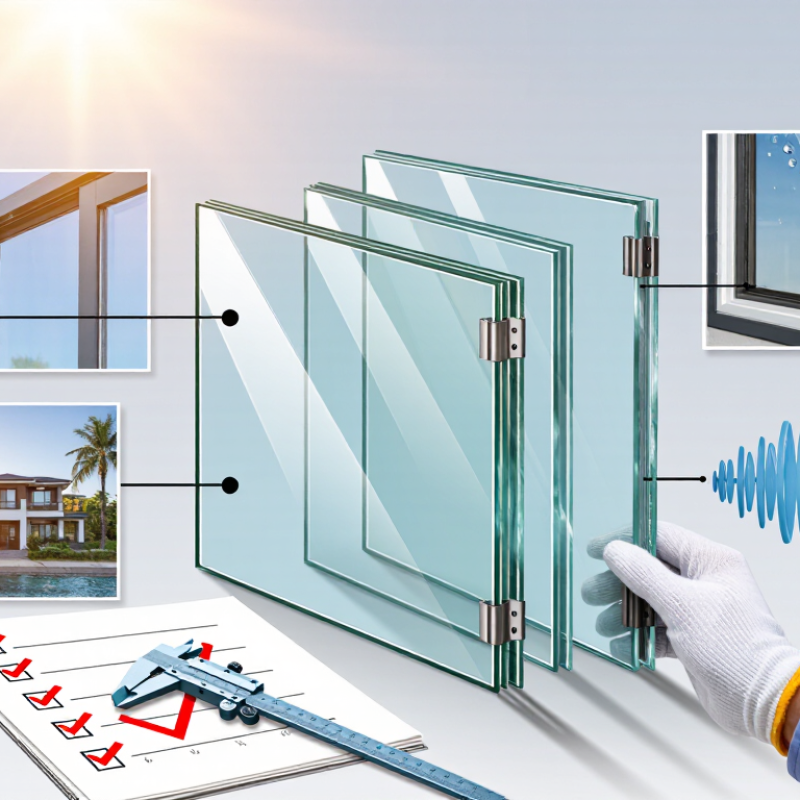
How to Choose Double Laminated Glass in 2026?

Clarify the Build: Two Laminated Lites and Four Glass Layers

When choosing double laminated glass in 2026, clarify the build before comparing performance figures. Here, “double laminated” should mean two laminated glass lites, not four separate panes. Each lite normally contains two glass plies bonded with an interlayer. Together, the unit presents four glass layers and two interlayers. That detail matters.

Ask for a section drawing, not only a product description. Check each glass ply’s thickness, heat treatment, and surface position. Confirm the interlayer type and its intended function, such as safety retention, sound control, or security resistance. The cavity between the two lites also needs attention. Its width, gas fill, spacer, and seal quality influence insulation and condensation performance. A thicker build is not automatically better. It may add weight and complicate frame compatibility.

For a reliable choice, match the glass to the room and exposure. Large low-level panels need impact-safe construction and carefully verified edge protection. Busy streets may justify acoustic testing with the complete frame, not glass alone. Ask for certified test reports, fabrication tolerances, and installation guidance. Small errors at the edge can weaken real-world performance. I would also challenge vague claims. “Four-layer glass” sounds impressive, but it can hide different ply arrangements. Review the actual make-up, then compare tested results. Sometimes the less dramatic specification is the more dependable one.

Select the Interlayer: Compare 0.38, 0.76, and 1.52 mm PVB Options

How to Choose Double Laminated Glass in 2026?

Choosing the PVB interlayer is not simply a thickness decision. The 0.38 mm option suits many standard interior partitions and low-risk glazing areas. It can hold glass fragments together after breakage. However, it offers less resistance to repeated impact and strong noise transmission.

The 0.76 mm option provides a more balanced solution for doors, shopfronts, balconies, and larger residential windows. Its added thickness can improve post-breakage integrity and reduce vibration. In practical inspections, edge quality matters just as much. Poor sealing, moisture exposure, or an unsuitable frame can weaken the complete unit. The interlayer alone cannot correct a poor installation.

The 1.52 mm option is intended for demanding applications requiring greater retention and resistance. It may support security-focused glazing designs, overhead panels, or areas with heavier human impact risks. Yet thicker does not automatically mean safer. Glass type, panel size, support conditions, heat, and tested performance must be checked together. A 1.52 mm layer can also increase cost and require more careful fabrication. That trade-off is easy to underestimate.

Ask for performance data from the glass processor, not only a thickness label. Confirm acoustic, impact, and weathering results for the exact build-up. Local requirements still matter. I would recheck the frame rebate and drainage details before approval. Small gaps can become large failures.

How to Choose Double Laminated Glass in 2026? — Select the Interlayer: Compare 0.38, 0.76, and 1.52 mm PVB Options

Selection Criteria 0.38 mm PVB 0.76 mm PVB 1.52 mm PVB
Typical designation 0.38 mm standard PVB 0.76 mm standard PVB 1.52 mm standard PVB
Assumed glass build-up for comparison 6 mm glass + 0.38 mm PVB + 6 mm glass 6 mm glass + 0.76 mm PVB + 6 mm glass 6 mm glass + 1.52 mm PVB + 6 mm glass
Nominal laminated thickness 12.38 mm 12.76 mm 13.52 mm
Approximate PVB mass per m² 0.41 kg/m² 0.82 kg/m² 1.64 kg/m²
Approximate total glass weight per m²* 30.41 kg/m² 30.82 kg/m² 31.64 kg/m²
Basic safety retention after glass breakage Suitable for basic laminated-glass safety applications when the complete assembly is correctly designed and tested Higher interlayer thickness generally provides stronger glass-fragment retention and improved post-breakage integrity Best of these three options for applications requiring increased post-breakage integrity, subject to system testing
Typical application level Interior glazing, low-risk partitions, small or moderate-size panels, and general safety glazing Overhead glazing, doors, larger panels, balustrades, façades, and areas requiring a more robust safety margin Overhead glazing, balustrades, guard panels, security-conscious designs, and large or high-consequence glazing
Resistance to panel separation after breakage Basic retention; the glass may lose more stiffness after fracture Improved retention compared with 0.38 mm, especially in larger panels Highest retention potential among the three, provided edge construction and support conditions are suitable
Acoustic performance Standard PVB offers limited improvement; glass thickness, air cavities, frame design, and sealing are also important May provide a modest improvement through greater damping, but it is not equivalent to acoustic-grade PVB May provide additional damping, but a tested acoustic PVB product is normally required for predictable sound-control targets
Ultraviolet protection Clear standard PVB typically blocks more than 99% of UV radiation below approximately 380 nm; confirm the exact product data Similar UV-blocking behavior to standard clear PVB; thickness alone should not be treated as a UV-performance guarantee Similar UV-blocking behavior to standard clear PVB; select a tested UV-control interlayer when a specific target is required
Visible-light appearance Normally clear with minimal visual impact when processed correctly Normally clear; optical quality depends on glass, PVB quality, lamination, and edge conditions Normally clear, but the greater interlayer thickness requires tighter control of lamination and edge finishing
Processing and fabrication difficulty Lowest material usage and generally the simplest option to process Moderate; commonly selected where safety performance and fabrication practicality need to be balanced Higher; requires careful autoclave processing, pressure control, trimming, and edge protection
Relative material cost Low Medium High
Best choice when Cost, low weight, and basic safety retention are the main priorities Best general-purpose balance
Safety, durability, weight, and cost all need to be balanced
Post-breakage integrity and higher-risk or overhead applications justify additional thickness and cost
Important limitation Not automatically suitable for overhead, guard, security, or large unsupported glazing Still requires structural calculations and project-specific safety testing Greater thickness does not by itself guarantee a higher legal classification or impact rating
Design note: Interlayer thickness is only one part of laminated-glass performance. Final selection should be verified against the complete glass build-up, panel dimensions, support conditions, wind and impact loads, temperature, edge exposure, and the applicable local standards. Safety classifications such as EN 12600, ANSI Z97.1, or CPSC 16 CFR 1201 must be confirmed by testing or approved engineering data for the complete assembly.
*Weight estimates assume two 6 mm soda-lime glass lites at approximately 2.5 kg per mm per m² and PVB density of approximately 1.08 kg/L. Actual values vary with glass composition, tolerances, coatings, and processing.

Verify Safety: Use ASTM C1172, ANSI Z97.1, and EN 12600 Ratings

How to Choose Double Laminated Glass in 2026?

Safety verification should begin with the glass specification, not its appearance. ASTM C1172 defines requirements for laminated architectural flat glass, including construction, quality, and performance. It helps confirm that two glass plies and an interlayer meet a recognized specification. Ask for the product thickness, interlayer type, and current test documentation. Do not accept a label without traceable records.

ANSI Z97.1 evaluates safety glazing through impact testing and breakage behavior. Check whether the tested construction matches your planned glass. A different thickness, interlayer, or edge treatment may change performance.

For European projects, EN 12600 uses pendulum-impact classifications, such as 1B1 or 2B2. These results should not be treated as automatic equivalents to ANSI ratings. They measure safety differently.

Look at the frame, too. A certified pane can still perform poorly when badly supported, chipped, or installed with the wrong setting blocks. I have seen attractive samples create false confidence. Small edge damage matters.

The safest choice links the standard, test report, dimensions, and installation method. Confirm the applicable building code with a qualified local professional. Standards are useful, but they are not magic. Test evidence can also become outdated when production details change.

Compare Performance: Target Over 99% UV Blocking and Tested Acoustic Data

How to Choose Double Laminated Glass in 2026?

Double laminated glass should be judged by measured performance, not attractive product claims. I learned this after comparing two samples that looked identical. One reduced street noise clearly, while the other barely changed the room’s sound level.

For ultraviolet protection, target over 99% UV blocking across the stated wavelength range. Ask for a current laboratory report, not a sales-sheet percentage. Check the glass thickness, interlayer type, test method, and light conditions. A small sample can perform differently from a full window assembly. That detail is easy to miss.

Acoustic performance needs tested data. Look for laboratory sound ratings, frequency graphs, and results for the complete frame system. A high rating at one frequency may not stop low bus noise or sharp motorcycle sounds. Request data near the frequencies affecting your building. Measure the existing room before replacement. A phone app can indicate patterns, but it is not a professional test.

Installation matters too. Gaps, rigid contact, and poor seals can weaken excellent glass. Ask the installer how edges will be supported and sealed. I would also compare visible light transmission, solar control, weight, and replacement access. More layers are not automatically better. Sometimes I focus too much on the headline number, and that is a mistake. A reliable choice leaves room for verification.

How to Choose Double Laminated Glass in 2026?

Compare performance by targeting more than 99% ultraviolet blocking while reviewing tested acoustic insulation data.

Representative laboratory performance values for common laminated-glass constructions. UV blocking is measured across approximately 280–380 nm, while acoustic performance is expressed as weighted sound reduction index Rw. Actual results vary with glass thickness, interlayer type, framing, installation, and test conditions. Confirm project values against EN 410 and EN ISO 10140 test reports.

Size and Certify: Apply ASTM E1300, NFRC U-Values, and 2026 Energy Codes

How to Choose Double Laminated Glass in 2026?

Choosing double laminated glass in 2026 requires more than comparing thickness and price. Start with the opening size, wind exposure, building height, and framing system. Apply ASTM E1300 to evaluate glass thickness and design load resistance. This standard supports proper sizing, but it does not replace a project-specific engineering review. A 1,200 mm by 2,400 mm panel may need a different build-up than a smaller panel in the same building.

NFRC U-values help measure heat transfer through the complete fenestration product. Check whether the quoted value covers the center of glazing or the whole window assembly. Frames, spacers, edge seals, and low-emissivity coatings can change performance.

Then compare the result with the 2026 energy code adopted in your project’s location. Requirements may differ between jurisdictions, and some authorities may still use an earlier edition. Confirm the local compliance path with the designer or code official.

Tips: Request test reports, calculation records, and product declarations before approval. Confirm the laminated interlayer, glass thickness, cavity width, and spacer type in writing. Ask for NFRC-certified values when available. Do not accept a rounded U-value without its boundary conditions. Small paperwork gaps cause large site delays. I have seen schedules fail because “double glazing” was treated as a complete specification. It is not. Review the details again before fabrication.

FAQS

What does a 0.38 mm interlayer suit best?

It suits standard interior partitions and lower-risk glazing areas. Broken glass fragments may stay together. It offers less resistance to repeated impact and strong noise transmission.

When is a 0.76 mm interlayer a practical choice?

It fits doors, shopfronts, balconies, and larger residential windows. The added thickness can improve post-breakage integrity. It may also reduce vibration. Edge quality still matters greatly.

Where might a 1.52 mm interlayer be appropriate?

It may suit overhead panels and areas with heavier human impact risks. It can support security-focused glazing designs. Thicker is not automatically safer.

Can a thicker interlayer fix poor installation?

No. Poor sealing, moisture exposure, and unsuitable frames can weaken the complete unit. The interlayer cannot repair bad installation. Small gaps become large failures.

What information should be requested before selecting laminated glass?

Request acoustic, impact, and weathering results for the exact glass build-up. Confirm the interlayer, glass thickness, cavity width, and spacer type. A thickness label is not enough.

How does panel size affect double laminated glass selection?

Check opening size, wind exposure, building height, and framing conditions. A 1,200 by 2,400 mm panel may need a different build-up. Use a project-specific engineering review.

How should glass thickness and design loads be evaluated?

Apply the relevant glass-sizing method for design load resistance. It helps evaluate thickness and panel performance. It does not replace engineering review.

What should be checked when comparing U-values?

Confirm whether the value covers the glazing center or the whole window assembly. Frames, spacers, edge seals, and coatings affect heat transfer. Rounded values can mislead.

How can a project avoid approval and installation delays?

Request test reports, calculation records, and product declarations early. Confirm local energy-code requirements with the designer or code official. Review the details again before fabrication.

Conclusion

Choosing Double Laminated Glass in 2026 starts with confirming its construction: two laminated glass lites, creating four glass layers separated by interlayers. The interlayer thickness should match the project’s needs. A 0.38 mm PVB option may suit basic protection, while 0.76 mm provides greater resistance and sound-control potential. For demanding safety, security, or acoustic applications, 1.52 mm PVB can offer increased stiffness and improved performance when properly engineered.

Verification is equally important. Review compliance with ASTM C1172, ANSI Z97.1, and EN 12600 to confirm the intended safety classification. Compare documented performance rather than relying on general claims, including a target of more than 99% UV blocking and laboratory-tested acoustic data. Final sizing should follow ASTM E1300, while NFRC U-values and applicable 2026 energy codes should guide thermal decisions. By evaluating construction, interlayer selection, safety ratings, acoustic and solar performance, dimensions, and certification together, buyers can specify glass that is both suitable and verifiable for the project.


Charlotte

Charlotte

Charlotte is a seasoned marketing professional with a deep understanding of the company's portfolio and a passion for elevating its presence in the market. With a keen eye for detail and a commitment to excellence, she ensures that our professional blog is regularly updated with insightful articles......