Float Glass supports modern buildings, vehicles, solar panels, and countless interior applications. Its smooth surface, consistent thickness, and optical clarity make it a foundation of architectural and industrial glass production. Yet, the global market is more complex than a simple list of famous names.
This guide examines the Top 10 Float Glass Manufacturers in the World through practical industry criteria. These criteria include production capacity, regional reach, product quality, research investment, sustainability efforts, and customer reliability. Manufacturing experience matters. So does technical consistency.
Large furnaces run continuously, often at extremely high temperatures. Small variations in heat, raw materials, or cooling can affect the final sheet. This is where engineering expertise becomes visible. A dependable producer must control these details from batch preparation to packaging.
The ranking should not be treated as absolute. Public data varies between companies, regions, and reporting years. Some manufacturers disclose detailed performance figures, while others provide limited information. That limitation deserves attention.
This overview combines industry reputation with observable business evidence. It considers companies serving construction, automotive, solar, and specialty glass markets. Readers can therefore compare more than factory size alone. Product range matters. Delivery reliability matters too.
The selected manufacturers represent different strengths. Some lead through scale and international distribution. Others stand out through advanced coatings, low-carbon production, or specialized processing. Their priorities are not identical.
A useful ranking should encourage careful evaluation, not blind acceptance. Buyers should still confirm certifications, technical specifications, lead times, and local support. This introduction sets the context for a balanced review of the world’s leading Float Glass manufacturers.
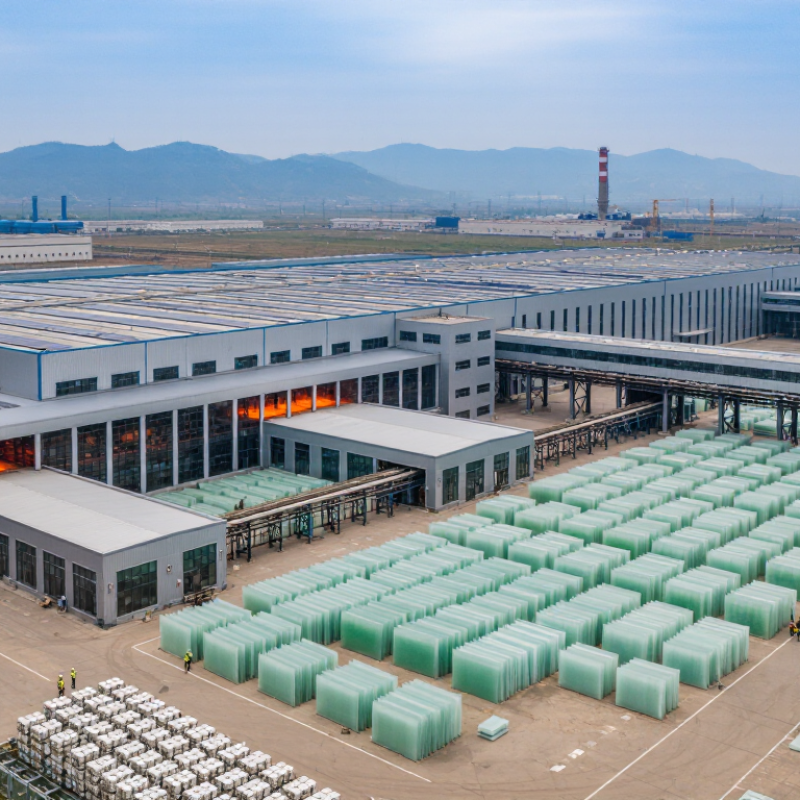
Float glass manufacturing begins with a furnace operating near 1,600°C. Silica sand, soda ash, limestone, and recycled cullet melt into a uniform liquid. The European Commission’s Best Available Techniques Reference Document for the Manufacture of Glass reports typical float-glass energy consumption of roughly 5–8 GJ per tonne. Exact figures vary with furnace age, cullet content, and product thickness.
The molten glass then flows continuously onto a bath of liquid tin. Its lower density lets the glass spread smoothly, while controlled rollers and temperature zones establish the final thickness. The tin surface must remain exceptionally clean. Even minor disturbances can create waves, optical distortion, or surface defects. The International Energy Agency identifies high-temperature process heat as a major industrial decarbonization challenge, making furnace efficiency increasingly important.
In practice, operators monitor flame balance, oxygen levels, bath temperature, and ribbon speed every minute. The Glass for Europe market review indicates that flat glass production remains closely connected to construction, vehicles, and energy-efficient buildings. That demand rewards consistency, but it also exposes weaknesses. Recycled cullet can reduce melting energy, yet contaminated input materials may damage quality. Published energy data also deserve caution because reporting boundaries differ. A modern line may appear efficient on paper, while maintenance losses remain hidden. The process looks simple. It is not.
Raw materials melt in a furnace near 1,600°C. Silica sand, soda ash, limestone, and recycled glass form a uniform liquid. The glass flows onto liquid tin and spreads into a smooth ribbon. It looks simple. It is not.
Liquid tin supports the molten glass because it is denser. The glass spreads evenly across its surface. Rollers and temperature zones control the final thickness. Small disturbances can create waves or optical defects.
Typical production uses roughly 5–8 gigajoules per tonne. Actual consumption depends on furnace age, recycled content, and glass thickness. Older equipment may lose energy through maintenance problems. Published figures are not always directly comparable.
Operators monitor flame balance, oxygen levels, bath temperature, and ribbon speed. These conditions may require checking every minute. A slight temperature change can affect thickness and waste. Human judgment still matters, perhaps more than the figures suggest.
Recycled glass can reduce the energy needed for melting. However, contaminated material may damage quality or disrupt production. Clean cullet is valuable. More recycled content is not automatically better.
Ten major manufacturing groups reportedly hold more than 90 million tonnes of annual capacity. The largest group approaches 12 million tonnes. Several others range from 7 to 10 million tonnes. Capacity figures should be treated as estimates.
No. Maintenance shutdowns, weak construction demand, and energy prices can reduce output. Some figures include announced projects or inactive furnaces. A smaller, modern line may outperform a larger aging system. The ranking is useful, but not final.
Float glass commonly ranges from 2 to 19 millimeters. It can serve windows, façades, doors, and interior partitions. Thicker glass may increase acoustic mass. It does not automatically provide better thermal insulation.
Thin clear glass often transmits about 88–91% of visible light. Tint, coating, and thickness can reduce transmission. A single pane may have a U-value near 5.8 W/m²K. An insulated coated unit can approach 1.6 W/m²K, but assembly design controls the result. Comparing single glass with complete window units is misleading.
Float Glass is produced through a highly controlled process in which carefully selected raw materials are melted at approximately 1,600°C before flowing onto a bath of molten tin. This method creates a flat, smooth, and uniform glass surface, making it suitable for precise cutting, coating, and further processing. The global industry can be evaluated by production capacity, revenue scale, regional presence, and reported 2024 performance, while comparisons often focus on annual output measured in million tonnes.
Leading manufacturers serve diverse markets, including construction, automotive, solar energy, and display applications. Their product ranges commonly cover thicknesses from about 2 to 19 mm, with performance assessed through light transmission, thermal insulation, and U-values. These characteristics influence energy efficiency, safety, appearance, and durability. By comparing manufacturing scale, product capability, technological investment, and market reach, readers can better understand how the world’s major producers compete and how Float Glass supports modern building, transportation, renewable energy, and advanced display industries.

 BYG.GLASS